

Peer review only works when experts genuinely evaluate the papers they review. As LLMs improve, overworked reviewers may be tempted to offload their work to AI, with no clear way to measure whether a review is human or machine-written. This can jeopardize the integrity of the peer review process.
To address this, we built a dataset of 788,984 LLM-generated peer reviews paired with human-written counterparts, spanning eight years of submissions to ICLR and NeurIPS. Using this dataset, we tested 18 existing AI-text detectors and developed Anchor, a context-aware method that uses the manuscript itself as a reference point.
Our findings suggest that detecting AI-generated peer reviews at the individual level is genuinely hard with current tools. We need better detection methods to protect the validity of the peer review process.
Why not offload reviews to LLMs?
AI research is booming, driving an unprecedented surge in paper submissions to leading conferences. At the same time, foundation models have advanced enough to generate convincing, authoritative-sounding analysis even in highly technical domains. Offloading heavy review workloads to LLMs might seem like a tempting solution, but doing so raises critical ethical and technical concerns. These include:
Bypassing reviewer expertise: Peer reviewers are selected specifically for their domain knowledge. Offloading reviews to an LLM undermines the expert vetting process.
Risks of hallucination: LLMs can generate plausible yet inaccurate feedback, casting doubt on their ability to evaluate complex research rigorously.
Undisclosed use erodes trust: Using LLMs without disclosure is a serious ethical breach that threatens confidence in scientific publication.
Lack of rigor: AI-generated reviews do not consistently align with human judgment and lack analytical rigor. Unregulated AI risks compromising the integrity of peer reviews.
Value
There’s a dearth of existing datasets for testing how well detection tools actually work in an academic setting. Although several benchmarks exist for evaluating AI text detectors, such as RAID-TD, M4, HC3 and GRiD, they typically evaluate multiple different source LLMs.
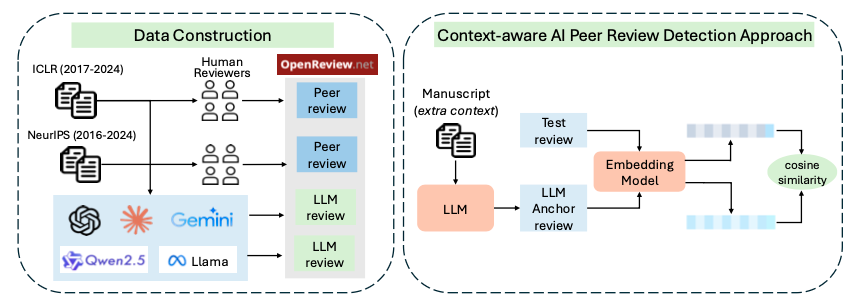
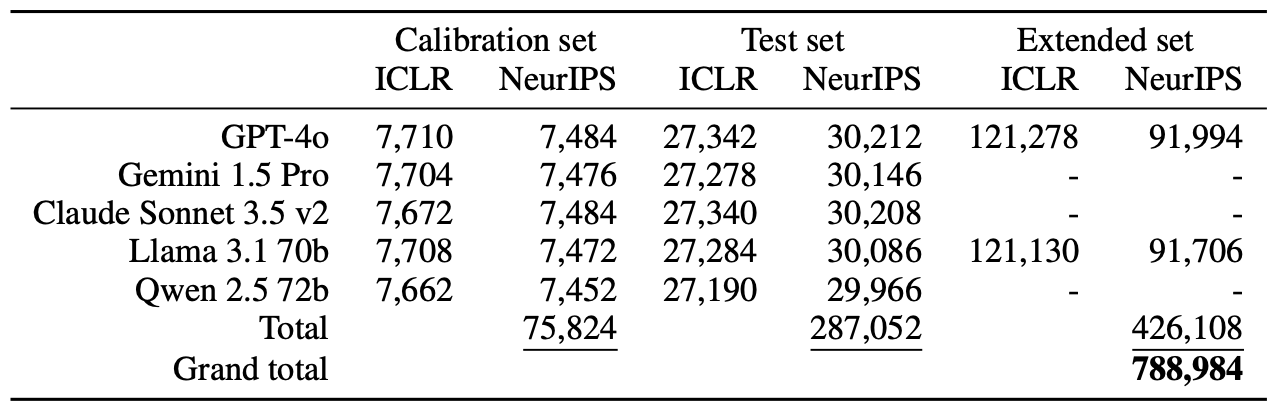
We therefore built the largest dataset of matched human and AI-written peer reviews, spanning eight years of NeurIPS and ICLR submissions. For each paper, we paired real human reviews with AI-generated ones. We evaluated five LLMs: GPT-4o, Claude 3.5 Sonnet, Gemini 1.5 Pro, Qwen 2.5 72B and Llama 3.1 70B. The dataset includes almost 789,000 reviews, split evenly between human and AI authorship.
We used this dataset to test 18 open-source AI text detectors. Unlike prior work that examined AI usage across the entire corpora, ours is the first to evaluate detection on individual reviews using controlled synthetic examples. This is a more realistic reflection of real world needs.
However, the results were discouraging: most detectors struggled to catch AI-written reviews without flagging genuine human submissions. To address this, we developed an approach tailored specifically to peer review. Because we can generate multiple reviews for a single paper using popular LLMs, our method measures semantic similarity between a given review and those reference points. This simple technique outperformed every existing detector on GPT-4o and Claude-written reviews. We also analyzed how partial AI editing affects detectability and what distinct signatures separate AI-written reviews from human ones.
Specific value additions:
A publicly released dataset: Contains 788,984 AI-written reviews matched with human reviews of the same papers.
A new detection method (Anchor): Compares semantic similarity to reference AI-generated reviews, performing well even under strict false-positive thresholds.
A benchmark of 18 detection methods: Shows that most existing tools fail to reliably catch AI-written reviews at low false-positive rates.
Key behavioral insights: Shows that AI-written reviews are less specific, more positive and more confident than human reviews.
Impact of AI editing: Demonstrates how partial AI-assisted editing affects overall detectability.
Quality assessment: Evaluates the overall quality of LLM-generated reviews.
Prior work explores LLMs in peer review and their effects on reviewing practices, simulated interactions, review quality, AI-assisted tools, transparency and AI-content detection. Our work differs from existing studies through our introduction of a new detection method, Anchor, which derives its strength from exploiting context unique to peer review: the manuscript being reviewed. By using the paper itself to generate a reference AI review, Anchor compares semantic similarity against candidate reviews.
This grounding makes Anchor more representative than methods like DNA-GPT, which regenerate text without source context. It’s also model-agnostic and works in a black-box setting, i.e. even when the LLM behind a fake review is unknown or API-only (unlike DetectLLM, which requires access to internal model weights).
Despite its simplicity, Anchor outperformed all 18 existing detectors on GPT-4o and Claude generated reviews. This was a strong result for a lightweight, purpose-built approach. We will examine this method in more detail below.
Dataset
We created a new dataset to match human-written and AI-generated peer reviews. To gather manuscripts and human peer reviews, we drew from two primary sources:
| Data source | Collection methods | Conference/Years |
ASAP dataset | Collected submitted manuscripts and their reviews | ICLR conference 2017-2018 |
ASAP dataset | Collected submitted manuscripts and their reviews from 2016-2019 | NeurIPS conference 2016-2019 |
OpenReview API | Collected submitted manuscripts and their reviews from 2019-2024 | ICLR conference 2019-2024 |
OpenReview API | Collected submitted manuscripts and their reviews from data | NeurIPS conference 2021-2024 |
LLM generation and infrastructure
We generated 788,984 AI peer reviews using five large language models (LLMs):
GPT-4o: Generated via Azure OpenAI Service.
Claude 3.5 Sonnet: Generated via Amazon Web Services.
Gemini 1.5 Pro: Generated via Google Cloud Platform.
Qwen 2.5 72B: Run on NVIDIA RTX 6000 GPUs.
Llama 3.1 70B: Run on Intel Gaudi 2 accelerators.
Each subset in the dataset is balanced, with an equal number of human-written and AI-generated reviews:
Calibration and test sets: Include reviews generated across all five LLMs.
Extended set: Includes reviews generated by GPT-4o and Llama 3.1 70B.
Anchor review (AR) method
To improve the detection of AI-generated peer reviews using manuscript context, we introduced the anchor review (AR) method. This approach compares a test review (TR) to a synthetic anchor review generated for the same manuscript using an LLM with a simple, generic prompt independent of the prompts used to create test reviews.
Detection process:
Embedding and similarity: We embedded both the AR and TR using OpenAI's text-embedding-3-small model and calculated their cosine similarity.
Threshold evaluation: If the similarity score exceeds a learned threshold (θ), we classify the review as AI-generated. We calibrated (θ) by applying this calculation to each review in the calibration set.
Multi-model voting: Because the source LLM is typically unknown, we generated multiple anchor reviews using different LLMs. A positive detection from any anchor review flagged the test review as AI-generated.
AR = LLM(paper, Prompt\(_{\text{AR}}\))
Emb\(_{\text{AR}}\) = EM(AR)
Emb\(_{\text{TR}}\) = EM(TR)
Score = Cosine_similarity(Emb\(_{\text{AR}}\), Emb\(_{\text{TR}}\))
Label = 1 if Score \(> \theta\) and 0 otherwise.
Cosine similarity measures how similar two vectors (embeddings) are by looking at the angle between them, not their length.
Formula:
\[ \cos(\theta) = \frac{A \cdot B}{\|A\| \times \|B\|} \]
\(A \cdot B\) = dot product of the two vectors
\(\|A\|, \|B\|\) = magnitudes (lengths) of each vector
Benchmark and evaluation method
We benchmarked our method against 18 existing detection approaches using the IMGTB tool.
Human review baseline
To ensure human-written reviews contained no AI assistance, we used reviews submitted before 2022 — prior to the public release of ChatGPT.
False positive rate control
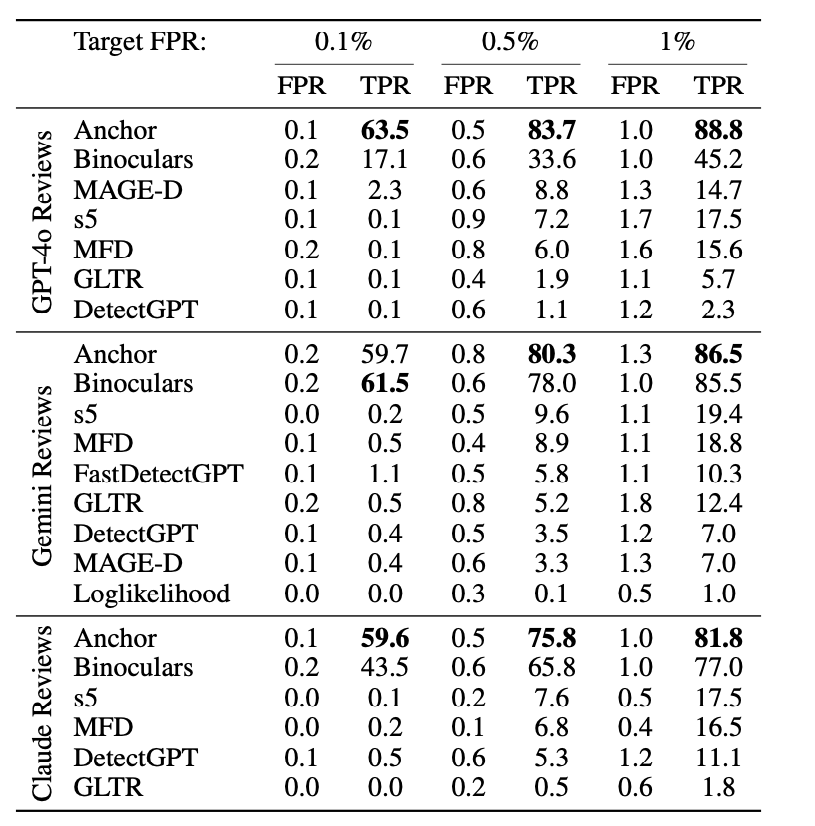
Because falsely accusing authors of using AI can cause significant reputational harm, we strictly limited the target false positive rate (FPR) to 0.1%–1%.
Model evaluation and ROC curves
We tested our approach against reviews generated by three commercial AI models: GPT-4o, Gemini, and Claude. To evaluate performance across varying detection thresholds while monitoring false positive trade-offs, we used receiver operating characteristic (ROC) curves.
Performance metrics
ROC curves illustrate the true positive rate (TPR) relative to false positives. While area under the curve (AUC) indicates overall detection accuracy, relying solely on AUC can be misleading because a model with a high overall score might still perform poorly at low FPR thresholds. To ensure rigorous evaluation, we reported actual TPR and FPR scores at discrete target FPR thresholds (0.1%, 0.5%, and 1%).
Cross-conference validation
To evaluate real-world generalization under strict conditions, we calibrated our models exclusively on ICLR reviews and evaluated them on reviews from other conferences.
Detection performance results
The Anchor review method outperformed all 18 baseline detection methods overall. By using the manuscript as context, Anchor proved especially effective at identifying AI reviews from advanced models, which are typically the hardest to detect without increasing false positives.
Model performance comparison
GPT-4o: At a strict 0.1% false positive rate (FPR), Anchor detected 63.5% of AI-generated reviews — significantly outperforming Binoculars at 17.1% (a 46-percentage-point improvement).
Claude 3.5 Sonnet: Anchor achieved a 59.6% true positive rate (TPR) compared to Binoculars' 43.5% at a 0.1% FPR.
Gemini 1.5 Pro: Anchor performed comparably to Binoculars, as Gemini-generated reviews were already easier for both methods to detect.
Analysis
We conducted additional analyses to answer the following questions.
Is AI peer review detection robust to prompt variations?
Instead of relying on a single fixed prompt, we used various personas, such as ‘balanced’, ‘conservative’ and ‘innovative’, to test whether detection performance would degrade. We observed that detection accuracy remained virtually the same. This suggests AI-generated reviews share consistent underlying patterns regardless of prompt framing, which means our dataset's usefulness doesn’t depend on specific prompts.
We also tested our hypothesis on advanced AI review-generation systems. Our results showed that more complex generation techniques do not make detection harder, supporting the broader usefulness of our benchmark.
Can detection models distinguish human reviews edited by LLMs?
In another experiment, we used AI to edit human reviews to test whether detection models could identify AI-human hybrid content. We created AI-edited versions across four levels: minimal, moderate, extensive and maximum.
From minimal to extensive editing levels, neither Anchor nor Binoculars flagged the reviews as AI-generated. However, at the maximum editing level, Anchor flagged about 60% of the reviews.
These results showed that while strong detection models can distinguish heavily edited text, lightly edited content remains difficult to detect highlighting the ongoing challenge of identifying hybrid content.
Can detection models detect mixed authorship peer reviews?
In our third experiment, we examined a mixed-authorship scenario. We provided the AI model with only a few bullet points and asked it to generate a complete review.
As expected, the Anchor algorithm rarely flagged these reviews as AI-generated. Because the model assisted only with drafting while the core ideas originated from humans, the content retained a predominantly human signal.
How do human-written and AI-generated peer reviews differ?
Our iterative analysis of 32 peer reviews authored by humans and GPT-4o revealed several key differences:
Specificity: Human reviews reference specific sections, tables, figures or results in the paper. GPT-4o reviews remain generic and high-level.
Related work: Human reviewers cite prior literature, challenge novelty and suggest specific baselines. GPT-4o reviews rarely engage with related work in detail.
Repetitive criticisms: Most GPT-4o reviews raise identical, generic complaints that are rarely seen in human reviews of the same paper.
Practical impact: Generic feedback from AI models can help authors polish manuscripts, but the lack of specific detail means AI models cannot replace expert human reviewers.
Role of prompting: Did poor prompting cause these gaps? No. Testing across varied prompt styles showed that prompting was not the underlying cause.
Do AI-generated reviews assign higher scores than human reviews?
Reviewers assign numeric scores alongside written comments across four standard peer-review categories used by conferences such as NeurIPS and ICLR: soundness, presentation, contribution and confidence.
We observed that AI models consistently assigned higher scores across all four categories than human reviewers did. Because scores strongly predict acceptance decisions, this systematic inflation raises fairness concerns potentially making AI-assisted papers more likely to be accepted than human judgment alone would dictate. Our findings align with prior studies on AI scoring bias.
Conclusion
We introduced a large-scale dataset pairing human-written and AI-generated peer reviews for papers submitted to top AI conferences. Our evaluations show that existing open-source detection methods fall short when applied to peer reviews.
We demonstrated that using the manuscript as context improves detection accuracy while keeping false positives low. Furthermore, AI-generated reviews lack specific details and remain less grounded in the manuscript than human reviews. Finally, our findings reinforce prior observations that AI models consistently assign higher scores than human reviewers, raising fairness concerns given how strongly scores influence acceptance decisions.
Further reading
The link to the paper: “is your paper being reviewed by an LLM? Benchmarking AI text detection in peer review”.
ICLR(International Conference on Learning Representations):
ICLR is a premier annual AI conference focused on representation learning and deep learning, typically held in spring. It's known for its open peer review process on OpenReview, where reviews are often publicly visible. It has an acceptance rate around 20-30%, using standard criteria like soundness, presentation, and contribution scores. In the study discussed earlier, ICLR papers were part of the dataset comparing human and AI-generated reviews.
NeurIPS (Conference on Neural Information Processing Systems):
NeurIPS is one of the largest, most prestigious AI/ML conferences, covering deep learning, neuroscience-inspired computing, and AI theory. Held annually in December, it has acceptance rates around 20-26%. Its review data is less openly public than ICLR's, but the 2022 edition was specifically used in the study since it predates ChatGPT, ensuring human-labeled reviews were genuinely human-written. Like ICLR, it uses similar scoring criteria to guide acceptance decisions, making it a key benchmarking venue each year.
Disclaimer
In addition to the original paper, we used Claude (operating within the Thoughtworks enterprise workspace) and Gemini (via the Thoughtworks on-brand — global brand voice pilot) to assist with diagram design and alignment with the Thoughtworks writing guide. Both are official AI models approved and licensed for use by Thoughtworks.